On a busy civil or asphalt site, the machine that earns its keep is rarely the biggest one. It is the one that can do the most jobs. A skid steer is small enough to work in tight spaces, but with the right attachment it can excavate, profile, sweep, load and lay material, often standing in for several larger machines and a crew of labourers at once.
That versatility is the whole point. Michael Tomic, Bobcat & Profiler Operator at Roadsafe Asphalt, puts the day-to-day role plainly: “we use the skid steer for excavation and propping crushed rock and site clean ups.” It is the machine that fills the gaps the larger plant cannot reach, and on most jobs it is chosen for a simple reason. As Michael says, “majority of the time other equipment are not practical for specific jobs.”
The real value shows up in what it removes from a site: the manual handling, the wheelbarrows, the second and third machine brought in for one task each. For the councils, civil contractors and project managers Roadsafe Asphalt works with across Melbourne and regional Victoria, a skid steer and an experienced operator are often what keep a job moving when the work gets tight, detailed or awkward.
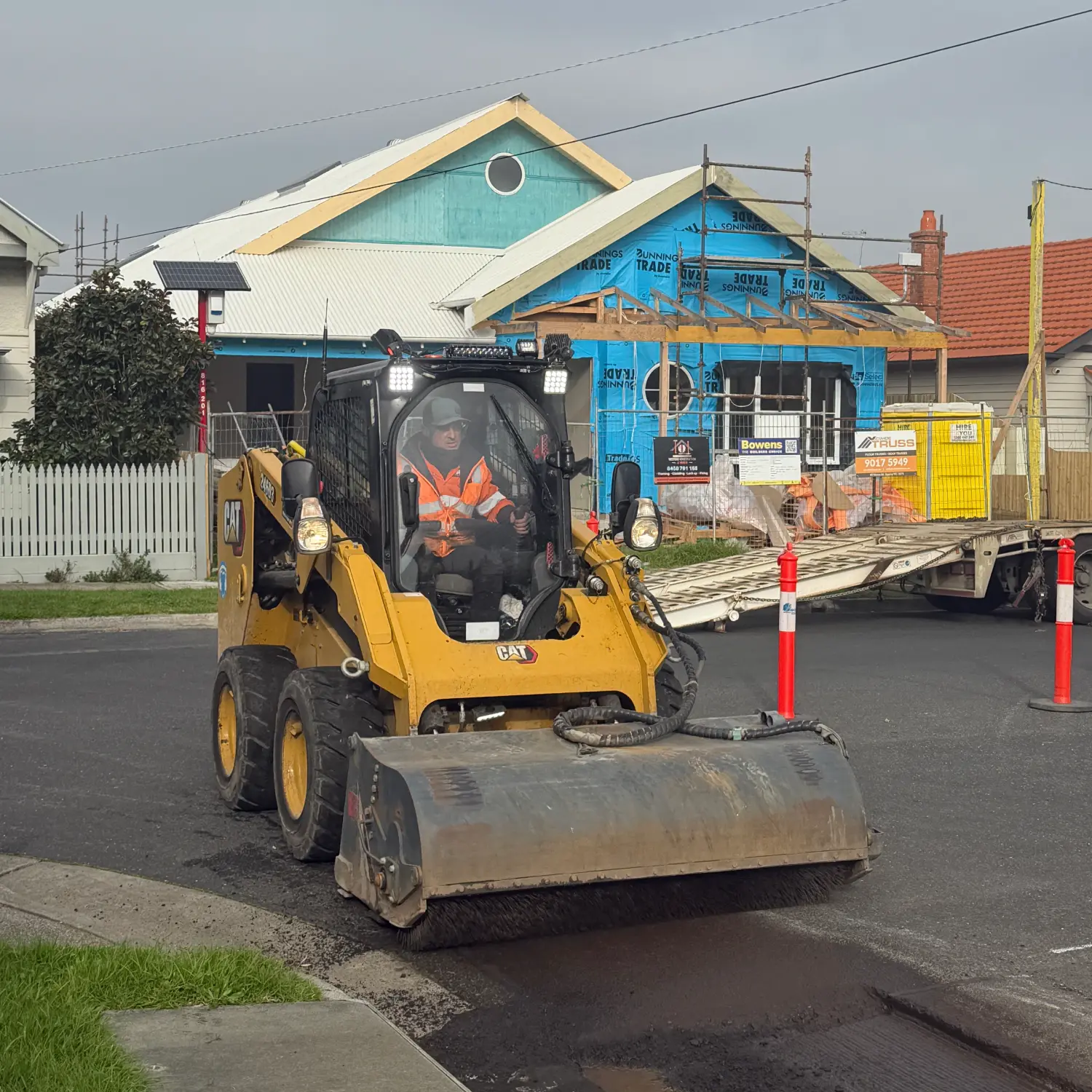
How the Right Attachment Turns a Skid Steer Into Multiple Machines
The reason a skid steer earns a place on so many jobs comes down to an economics most people do not stop to think about: one machine, one operator and one float to site, covering work that would otherwise mean a profiler, a loader, a sweeper and a small excavator each turning up separately. The power unit stays put. The tool on the front changes to suit the task, and that is what lets one skid steer do work that would otherwise need several separate machines.
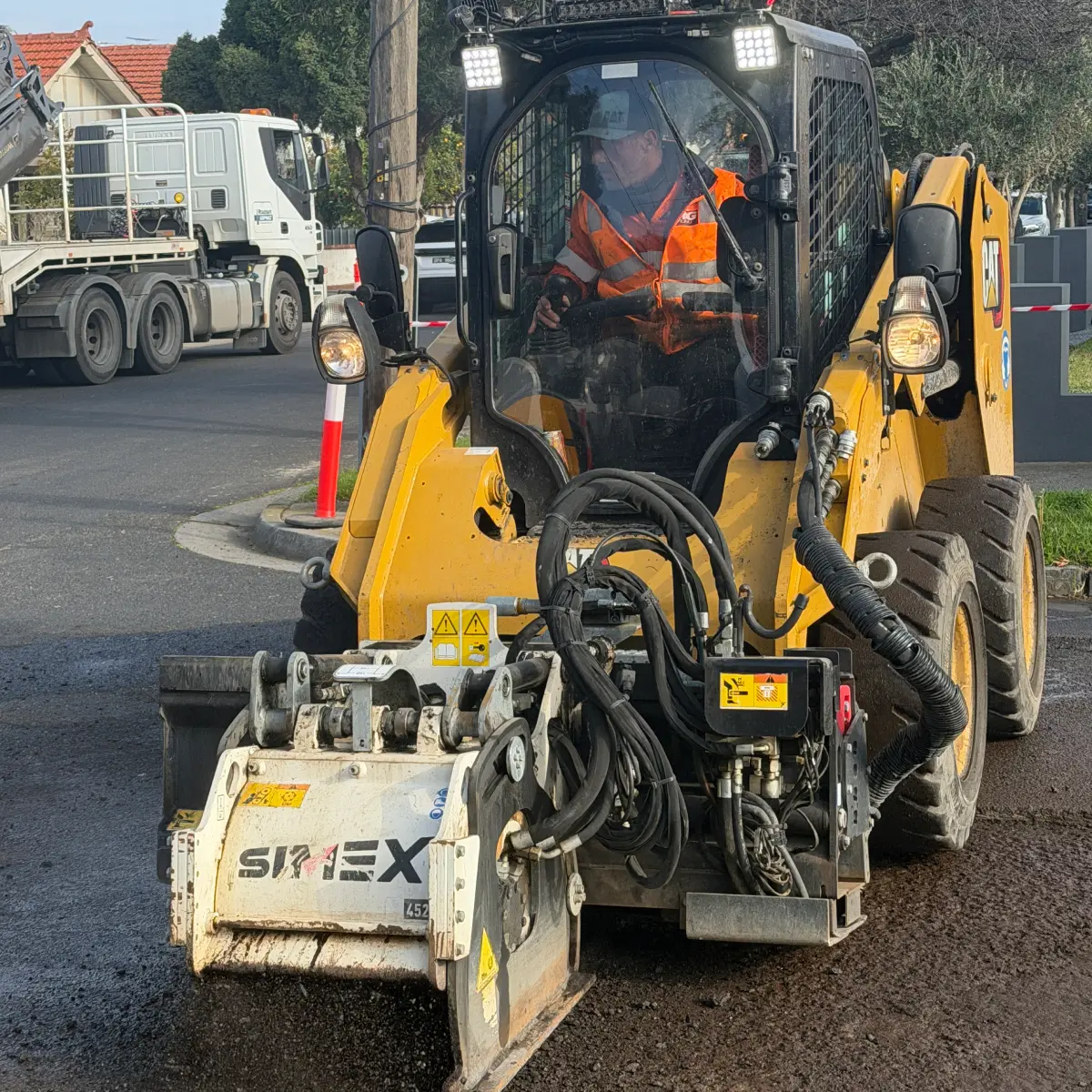
Michael runs through the attachments that matter most on asphalt and civil jobs, and each one replaces something. “Attachments include a mill which is used for profiling for specific depths,” he says, along with a “broom attachment used for site clean ups” and a bucket “used for unloading asphalt and laying asphalt where we cannot use pavers at specific job sites, and also used for excavation and back blading of crushed rock.” One machine, fitted in turn, does the work of a profiler, a sweeper, a loader and a small excavator.
The common attachments and what they do:
- Mill (profiler): cuts the existing surface to a controlled depth rather than breaking it out, for small or detailed profiling work.
- Broom: sweeps and clears the site, replacing manual clean-up.
- Bucket: unloads and lays asphalt where a paver cannot reach, and handles excavation and back blading of crushed rock.
That range is why the skid steer is so often the machine that finishes a job: it gets into the spots the larger plant cannot, and it changes role in minutes rather than waiting on another machine to arrive.
It is worth settling one common question here, because it comes up on almost every job: the difference between a skid steer and a bobcat. There is not one. As Michael puts it, “a skid steer is the type of machine, while Bobcat is a highly popular brand. Both are used in the same context.” Bobcat is simply a manufacturer whose name became shorthand for the machine itself, so when a contractor asks for a bobcat, they almost always mean a skid steer loader, and the work is identical.
Skid Steer Hire for Base Preparation, Trenching and Asphalt Patching
Ask a site supervisor which machine they would keep if they could keep only one, and on a tight job the answer is often the skid steer. Not because it does any single task best, but because it does the dozen small ones that otherwise stall a crew. It is rarely the headline machine, but it is often the one that makes the rest of the site work.
Common deployments include:
- Excavation and propping of crushed rock to form a properly prepared base for the new pavement.
- Asphalt loading and laying in tight spots where a paver cannot reach.
- Small or detailed profiling with a mill attachment.
- Council patching and maintenance programs and site clean-ups across a road network.
- Trench and reinstatement support on civil works packages in constrained urban sites.
On council and infrastructure work, it is the machine that handles the parts of a job the larger plant is too big for, which is exactly why it is so often on site from start to finish.
Trench reinstatement is a good example of why the detail matters. On local council roads, the work is tightly specified: the excavated spoil cannot simply go back into the trench, and the crushed rock used to rebuild the base has to meet the relevant pavement-material standard. A skid steer is the machine that moves the old material out, brings the specified crushed rock in, and spreads and levels it ready for compaction, the close, repetitive, in-and-out work that a larger machine cannot do in a confined trench.
How a Skid Steer Improves Productivity and Reduces Manual Labour
The clearest return a skid steer brings is measured in the labour it takes off a job. The heavy, slow, manual parts, the lifting, the barrowing, the hand-clearing, are exactly the work it absorbs, and a task that once tied up a small crew with barrows now moves at the pace of one machine and one operator.
Michael is plain about the difference it makes. “It takes away a lot of manual handling and heavy lifting,” he says, and on a site that has always relied on muscle, that changes the pace of the whole job. He puts the productivity gain just as simply: a skid steer “eliminates the use of wheelbarrows and aides in working more productively.”
There is a safety dimension to this that project managers often miss until they see it. Michael points to loading and unloading “on tight angles and slopes,” where the machine “becomes light with no attachments as machine will easily roll.” A skid steer is most stable worked on level ground with the load low, and running one safely on slopes and uneven surfaces depends on a trained, competent operator reading those limits. This is the kind of judgement that separates a productive day from a damaged machine, and it depends entirely on the operator, which is where hiring matters most.
Why Every Roadsafe Asphalt Skid Steer Hire Includes an Experienced Operator
A skid steer on its own is potential, not performance. The attachments give it range, but it is the operator who turns that range into a job done well, and on a tight or sloping site, safely. This is the heart of skid steer hire: you are not just hiring a machine, you are hiring the person who knows how to use it.
Michael is clear about what experience buys. “An experienced operator can manoeuvre the machine in tight spaces to its limit,” he says, working the skid steer into the confined, awkward spots that are the whole reason it was brought to site. The same experience reads the risks, the slopes, the angles, the moment the machine goes light at the rear, before they become a problem rather than after.
That experience is a defined competency, not a vague claim. The national standard for civil construction skid steer operation sets out what a competent operator must do: run pre-start checks, drive and operate the machine to the conditions on site, estimate safe working loads, select and fit the right attachment within its limits, and identify and control hazards as the work changes. When the operator comes with the machine, that competency is part of what is hired, rather than something the client has to supply, verify and supervise.
Every skid steer Roadsafe Asphalt puts on site comes with an experienced operator. That is the wet hire model, and it is also where the burden of running the machine shifts off the client. Because the machine comes with the operator, the operational risk, maintenance and compliance stay with Roadsafe Asphalt, which carries public liability, workers compensation and plant insurance, and manages the pre-start inspections, maintenance records and safe work procedures the work requires.
The machine is the same on a dry hire. What changes is the judgement of the person on the controls, and whether the risk of operating, maintaining and certifying the plant sits with the client or with Roadsafe Asphalt. Hiring the operator with the machine is what turns a versatile tool into a job that runs.
Nearly 20 Years of Skid Steer Expertise Supporting Victoria’s Contractors
With nearly 20 years of operation across Melbourne and regional Victoria, Roadsafe Asphalt works with councils, contractors and asset owners to deliver reliable, compliant asphalt and civil outcomes. Skid steer hire is backed by over 45 major fleet and plant equipment, experienced wet-hire operators, a full range of attachments, regularly serviced and compliant machines, safety systems including Safe Work Method Statement (SWMS) and permits, and prequalification to Department of Transport and Planning standards.
Behind the fleet is the experience that keeps a site moving. Many of Roadsafe Asphalt’s customers have stayed with the business for more than 15 years, across hundreds of successful projects throughout Victoria, spanning local councils, major contractors, utilities and transport providers across rail, civil and utility infrastructure.
For a council or contractor, the real value is in what they no longer have to manage. The machine is matched to the job by people who have made that call thousands of times, the operator brings the competency and the judgement, and the ownership burden, the servicing, the certification, the breakdown cover, never crosses onto the client’s books. The job proceeds; the administrative weight stays with Roadsafe Asphalt.
Whether you are propping a base, clearing a site or laying asphalt in a spot a paver cannot reach, the right skid steer and an experienced operator keep the job moving. Get a fast quote for your next skid steer hire project, or speak with our plant and equipment hire specialist about the machine behind your project.
Frequently Asked Questions (FAQs)
What is a skid steer used for on a civil or asphalt site?
Excavation, propping crushed rock, site clean-ups, small profiling, and loading and laying asphalt in tight spots where a paver cannot reach. With different attachments it covers work that would otherwise need several machines.
What is the difference between a skid steer and a bobcat?
None in practice. A skid steer is the type of machine; Bobcat is a popular brand whose name is often used for the machine itself. They are used in the same way on site.
What attachments are available for a skid steer?
Common attachments include a mill for profiling to a set depth, a broom for site clean-ups, and a bucket for unloading and laying asphalt, excavation and back blading crushed rock.
Does Roadsafe Asphalt skid steer hire include an operator?
Yes. Roadsafe Asphalt operates on a wet hire model, so an experienced operator comes with every machine. The operator manages the machine in tight spaces and on slopes, where experience keeps the work safe and productive.
Why hire a skid steer instead of using manual labour?
A skid steer takes away much of the manual handling and heavy lifting on a site and eliminates the need for wheelbarrows, which lets a job run faster with less strain on the crew.
What projects use skid steer hire?
Council patching and maintenance, site clean-ups, base preparation, small profiling, and asphalt and civil works across Melbourne and regional Victoria.