The quality of an asphalt surface is decided long before the new material is laid. It is decided by the milling pass underneath it. A road profiler cuts the old, failed pavement back to a clean, level base, and the asphalt that goes on top takes the shape of whatever that base leaves behind.
Get the milling right and the finished surface is flat and true. Get it wrong and the surface follows every bump and dip of an uneven cut. This is controlled removal of pavement to correct shape and restore ride quality, not rough demolition, and the difference between the two is where a job is quietly won or lost.
Phil Mifsud, 1m & 2m Profiler Operator at Roadsafe Asphalt, puts it in terms anyone who has laid asphalt understands. Early in his career, an older colleague gave him an analogy he still uses: “take a coin and with a pencil and paper you can transfer the exact image of the coin onto the paper. This holds true to the asphalt surface. The surface will conform to the subbase and base of the given project.”
For the councils, civil contractors and infrastructure managers Roadsafe Asphalt works with across Melbourne and regional Victoria, that is why the profiler, and the operator on it, decides far more about the finished surface than its quiet role on a job suggests.
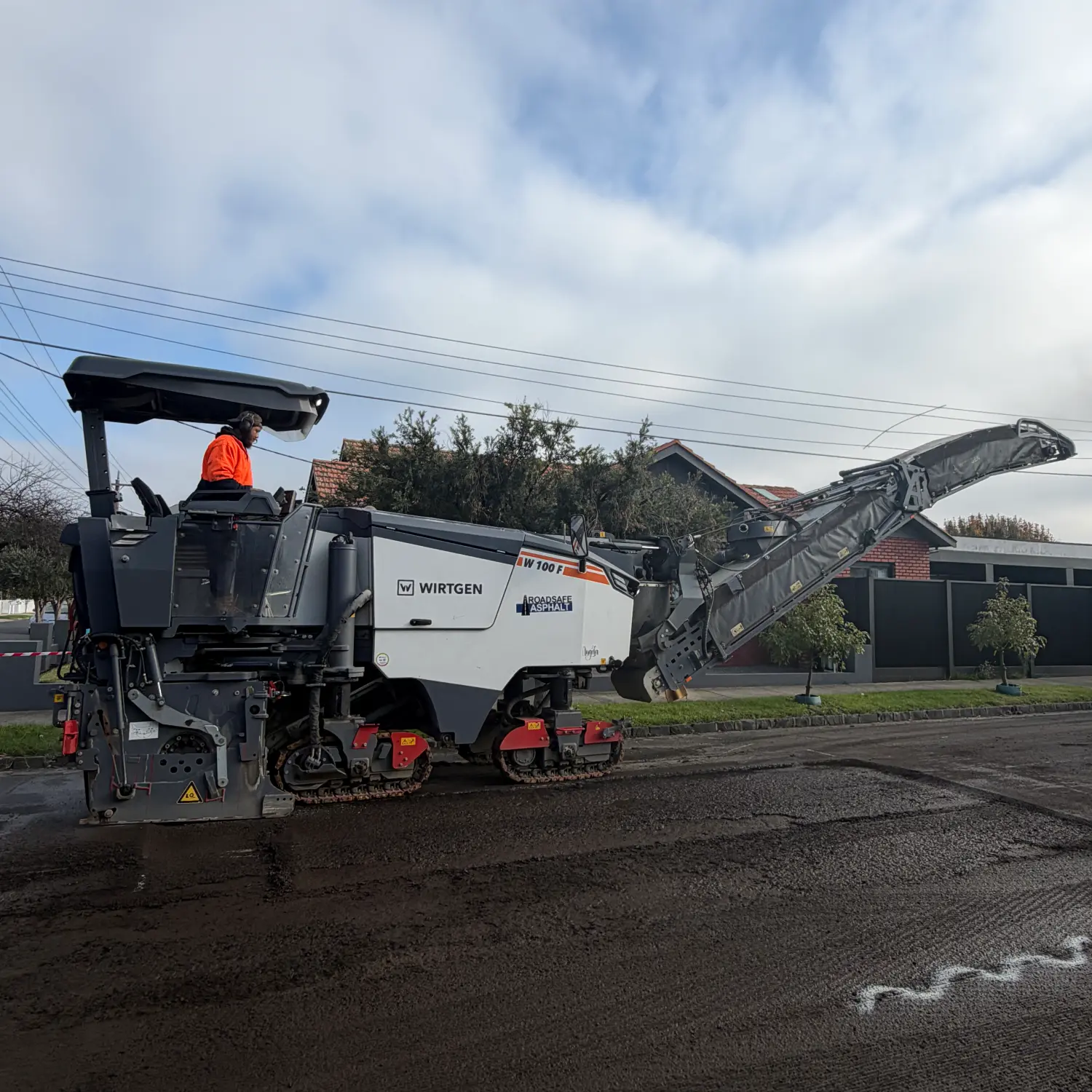
A Smooth Asphalt Surface Begins with an Accurate Cut
Asphalt profiling, also called milling or cold planing, is the removal of an existing pavement cut to a controlled depth rather than broken out, leaving a clean, even base ready for new asphalt. A profiler runs a rotating drum fitted with cutting teeth that grind the old surface away, while the milled material is carried up and out into a waiting truck. To anyone watching for the first time, it can look like chaos.
Phil is the first to admit it. “Profiling can be quite daunting and intimidating to see at first,” he says. “Loud machinery and what looks like chaos turns out to be a graceful dance of perfectly timed actions, with enough time and experience anything can be mastered.” What looks like disorder is a precise, coordinated operation, with the profiler, the trucks and the crew all moving in sequence to the same tempo.
That precision matters because of the coin-and-paper principle. The new layer cannot be flatter than the surface it is laid on. As Phil puts it, “with an uneven base the top surface will be bumpy and uneven, but with a perfectly flat and solid base the asphalt will be flat and level.” A clean, level cut gives the paving crew a base they can lay a true surface on. A poor cut hands them a problem they cannot fix with asphalt, because the new layer will simply follow the shape of the base underneath.
This is why the milling pass is not a preparatory detail. It is the thing that sets the ceiling on the finished surface, and it is why the standards treat the milled surface so carefully. The milled base has to be cleaned and prepared before the new layer goes down, and the cut itself has to hold a controlled, even level.
The stakes are financial as much as technical. If a surface goes down on a poor base and has to be redone, Phil notes the most common result is “a total blowout of the projects budget,” along with a sub-optimal level that can fail later or be rejected outright by the council.
When You Should Hire a 1m Profiler Instead of a 2m?
Once the cut is understood as the thing that sets the surface, the next question is which machine makes it. The choice between a 1m and a 2m profiler comes down to the size, depth and complexity of the job, and the two suit genuinely different work. The call is made early, at the preconstruction inspection, where the supervisor sizes up the job before any machine is booked.
As Phil explains it, the supervisor determines the machine “by taking into account the width, depth, length and overall area of the job at hand.” Larger, deeper jobs need a larger, more powerful machine; smaller, more complicated ones need a smaller, more agile one.
The 2m profiler is the machine for large, open jobs: highways, freeways and full suburban streets, as well as deep-lift work. It clears volume fast. Phil points to the Westgate Tunnel, where the floor needed excavating in places up to three metres deep, and a large 2m machine was brought in to do it.
The 1m profiler is the machine for tighter, more complex work, and its real strength is mobility. Phil describes one contract with a run of separate patches and trenches scattered across Melbourne, work that suited a quick in-and-out approach, floating the 1m machine between a number of jobs in a single day. In short:
- 2m profiler: large, open, deep jobs. Highways, freeways, full streets, car parks and deep-lift excavation.
- 1m profiler: tight, complex, mobile work. Patches, trenches and intricate shapes that need a machine moved between sites through the day.
Why the Right Machine Choice Pays Off Before the Cut Begins
Choosing between the two machines is only worth doing if the choice is made properly, and the cheapest way to save money on a milling job is to get the machine and haulage right before the work starts. The decisions taken at the booking, which profiler, which trucks, set the cost and the timeline more than anything that happens during the cut, and Phil names truck allocation as the one most often misjudged.
The instinct is to match a big truck to a big job, but the site governs the choice as much as the volume. As Phil explains, “a larger job won’t necessarily need a larger truck because of where the job’s location is.” A large job on a tight suburban street with low branches needs a smaller, more manoeuvrable truck, a twin-steer tandem or a separable truck and trailer, because a large truck that cannot work to full capacity only slows the operation down.
The second is bringing in the wrong machine size. It is rare, but it happens, and almost always at the client’s request to cut running costs. Where a smaller machine can still do the job, Phil notes the crew will go ahead and cut, on the understanding that it will take significantly longer but can still be done to an excellent standard with patience. Otherwise the job is rescheduled, or the right machine is brought in on the day at extra cost.
The irony, as Phil points out, is that demanding the smaller machine “almost certainly costs more in the long run due to time wastage.” Both mistakes are avoided the same way: size the machine and the haulage to the job at inspection, and listen to the operator when the booking does not match the work on the ground. That judgement, made before the machine starts, is exactly what an experienced hire brings to the job.
Profiler Hire for Road Resurfacing, Council Patching and Civil Works
Whichever machine the job calls for, profilers turn up across most resurfacing and reconstruction work, which is why they are central to the asphalt and civil services Roadsafe Asphalt delivers for councils, contractors and infrastructure managers. The common thread is that an old surface has to come up, cleanly and to depth, before a new one can go down.
Common deployments include:
- Road resurfacing on highways, freeways, arterial roads and suburban streets.
- Deep-lift excavation on large infrastructure projects, including major works like tunnels and car parks.
- Council patching and maintenance programs, where failed sections are milled out across a road network.
- Trench reinstatement and civil works packages across constrained urban sites.
On government and local council works, profiling is the first step that determines whether the resurfacing that follows performs, which is why the milling pass is treated as critical rather than preparatory.
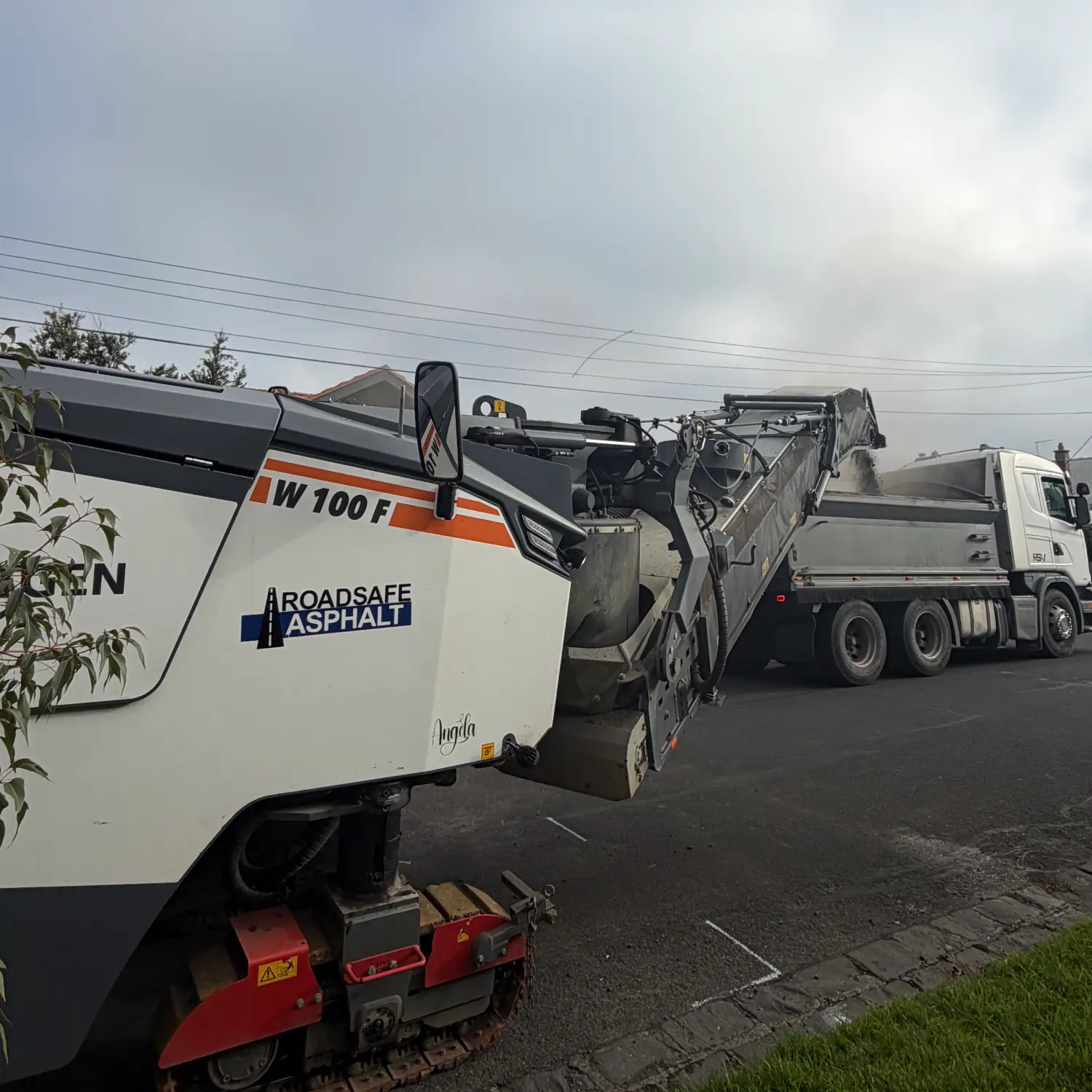
Roadsafe Asphalt Includes an Experienced Operator with Every Profiler Hire
This is the heart of profiler hire, and it is the part that does not show up in a day rate. When you hire a profiler from Roadsafe Asphalt, the machine is only half of what arrives. The other half is an operator who knows how to read the job and make the cut hold, and on milling work that judgement is the difference between a surface laid once and a surface laid twice.
Phil is direct about what rides on the person running the machine. “A more experienced operator can mean the difference between a perfect job and a job that needs to be redone,” he says, and a job redone brings a cascade behind it: the budget blowout, the sub-optimal level, the surface that fails in future or gets rejected by the council. The cut has to be right the first time, and that depends on the operator.
There is a less obvious side to it, and it is about pressure. Phil describes “the sheer stress of operating large machines in smaller spaces,” where a mistake can mean damage to the machine or to property, and where in his experience the damage is “a direct link to how much stress the given operator is under.” The value of a genuinely experienced operator is that the skill makes a hard job look easy. As he puts it, the problems that arise during a job “are negotiated and the best course of action is performed to acquire the best outcome.”
The machine is identical on a dry hire. What changes is the judgement of the person on the controls, and with it, whether the burden of risk, maintenance and compliance sits with the client or with Roadsafe Asphalt.
Nearly 20 Years of Matching the Right Profiler to the Right Job
With nearly 20 years of operation across Melbourne and regional Victoria, Roadsafe Asphalt works with councils, contractors and asset owners to deliver reliable, compliant asphalt and civil outcomes. Profiler hire is backed by over 45 major fleet and plant equipment including 1m and 2m profilers, experienced wet-hire operators trained in asphalt and civil works, regularly serviced and compliant machines, safety systems including Safe Work Method Statement (SWMS) and permits, and prequalification to Department of Transport and Planning standards.
Behind that fleet is the part that sets the surface: the experience. Many of Roadsafe Asphalt’s customers have stayed with the business for more than 15 years, across hundreds of successful projects throughout Victoria, spanning local councils, major contractors, utilities and transport providers across rail, civil and utility infrastructure, including major works where the milling pass had to be exact. That kind of retention is earned over time by getting the cut right, job after job.
For a council or principal contractor, the value is that the machine, the operator and the compliance come as one. Both machine sizes are available, so the profiler is matched to the job rather than the job to the profiler, and the operator experience is what keeps the cut clean and the surface true.
Whether it is a highway resurfacing, a deep-lift excavation or a network of tight patches, the right profiler and an experienced operator give the paving crew a base they can lay a true surface on. Get a fast quote for your next profiler hire project, or speak with our plant and equipment hire specialist about the milling behind your project.
Frequently Asked Questions (FAQs)
What is asphalt profiling?
The controlled removal of an existing asphalt surface to a set depth, using a profiler with a rotating cutting drum. It leaves a clean, even base for new asphalt and is also called milling or cold planing.
Does Roadsafe Asphalt profiler hire include an operator?
Yes. Roadsafe Asphalt operates on a wet hire model, so an experienced operator comes with every machine. On milling work the operator is the difference between a clean cut done once and a job that has to be redone.
What is the difference between a 1m and a 2m profiler?
The 2m profiler suits large, open and deep jobs such as highways, full streets, car parks and deep-lift excavation. The 1m profiler suits tighter, more complex work such as patches and trenches, and can be floated between sites through the day.
Why does the milling pass matter so much?
Because asphalt conforms to the base it is laid on. A flat, level cut gives a flat surface; an uneven cut gives a bumpy one, regardless of how well the asphalt is laid. The milling pass sets the ceiling on the finished surface.
How deep can a profiler cut?
It depends on the machine and the job. Larger 2m machines handle deep-lift excavation, in some cases several metres deep across multiple passes, while patching work is milled to match the pavement layer being replaced.
What projects use profiler hire?
Road resurfacing, deep-lift excavation, council patching and maintenance programs, and trench reinstatement across Melbourne and regional Victoria.